


Going armed to the terror of the people is a common-law crime in North Carolina, punished as a Class 1 misdemeanor. Since the North Carolina Supreme Court’s 2023 decision in State v. Lancaster, the conduct no longer has to happen on a highway.
The State must prove you went about armed with an unusual and dangerous weapon, in a public place, to frighten people, in a way that would naturally frighten them.
Carrying a gun openly is not, by itself, this crime. The purpose and the manner are what the State must prove.
Whether your conduct meets those elements is exactly what a defense lawyer tests.
Charged with going armed to the terror of the people in Greensboro or High Point? Call (336) 379-0539 so a lawyer can review the video and witness statements now.
What Does “Go Armed to Terror of People” Mean?
It means carrying a dangerous weapon in public in a way meant to scare people. The charge often appears on paperwork as “go armed to terror of people.”
It is a common-law crime, defined by courts, such as in State v. Dawson, 272 N.C. 535 (1968). So it has no G.S. section of its own, and its punishment comes from a general rule:
“[E]very person who shall be convicted of any misdemeanor for which no specific classification and no specific punishment is prescribed by statute shall be punishable as a Class 1 misdemeanor” (G.S. 14-3(a)).
The UNC School of Government applies that rule to this crime. See how we defend misdemeanor charges in Greensboro, including weapons cases.
What Changed in 2023: State v. Lancaster
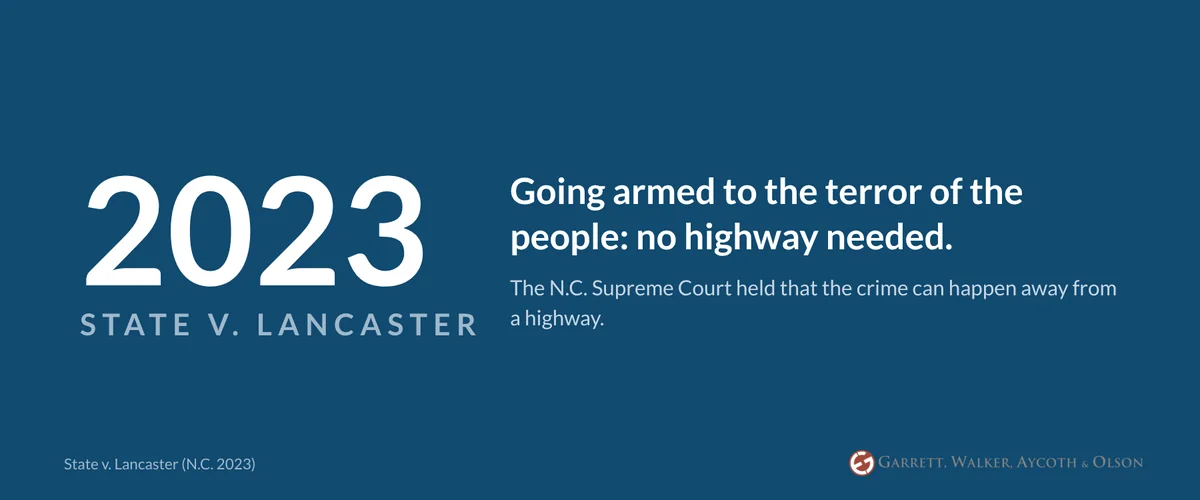
In December 2023, the North Carolina Supreme Court held that the crime can happen away from a highway. The court wrote:
“[T]he crime of going armed to the terror of the public does not require that the offensive conduct occur about a public highway” (State v. Lancaster, N.C. 2023).
The case involved a man waving a gun and firing rounds in an apartment complex parking lot. The court overruled an older case that had required a highway.
So a parking lot or a store can now be enough.
The court listed “in a public place” as an element but did not define it. So where the line falls is argued case by case, and that is where a lawyer’s work starts.
Since that 2023 decision, the charge does not depend on a highway.
The Four Elements the State Must Prove
The State must prove four elements beyond a reasonable doubt, as listed in the School of Government’s summary of Lancaster.
Armed with an unusual and dangerous weapon: The 1999 pattern jury instruction says “A weapon is an unusual weapon if it is not usually carried by a person while on the public highways.”
It adds that a weapon is dangerous “if it is likely to cause death or serious bodily injury.” The highway wording was written before Lancaster dropped the highway requirement.
In a public place: After Lancaster, this is no longer limited to highways.
For the purpose of terrifying people: The State must show you armed yourself to frighten and alarm the peaceful people.
In a manner that would naturally terrify people: The way you carried or used the weapon must be the kind that would naturally alarm people.
Purpose is usually argued from what you did and said. That is why the facts, and how they are told, matter so much.
Is a Gun an “Unusual and Dangerous Weapon”?
Usually, yes. An 1843 case, State v. Huntly, called a gun “an ‘unusual weapon,’ wherewith to be armed and clad,” as quoted by the School of Government.
A gun is also plainly able to cause death or serious injury. So in most gun cases, the real fight is about purpose, place and manner, not the weapon.
Talk to a defense lawyer before you talk to anyone else
What you say and sign in the first days often decides what is possible later. The earlier we see your paperwork, the more options you usually have.
Call (336) 379-0539Free consultation with a Greensboro attorneyOpen Carry vs Going Armed to the Terror of the People
North Carolina makes it a crime to carry a gun concealed unless you are on your own premises or hold a valid concealed handgun permit (G.S. 14-269(a1)).
North Carolina statutes do not ban carrying a gun openly in general. But some places are off limits, even for open carry.
Weapons are banned at parades, funeral processions, picket lines and demonstrations on public property (G.S. 14-277.2). Guns are restricted at schools (G.S. 14-269.2), alcohol establishments (G.S. 14-269.3) and State property (G.S. 14-269.4).
Cities and counties cannot write their own gun rules unless a statute allows it (G.S. 14-409.40).
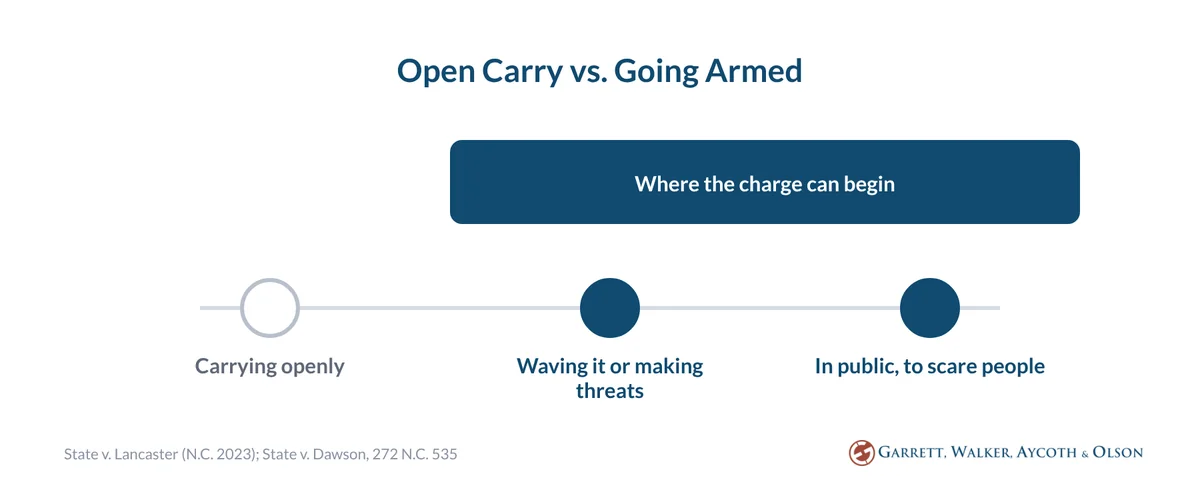
What turns lawful carrying into this charge is acting in a public place, to scare people, in a way that naturally would, such as waving the gun or making threats. Actual fright of a witness is not a listed element.
Carrying openly is where it starts; waving the gun to scare people is where the charge begins.
Pointing a gun at a person is its own crime, a Class A1 misdemeanor (G.S. 14-34). If you were charged with carrying a concealed gun, the rules are different.
Penalties for Going Armed to the Terror of the People
It is a misdemeanor, not a felony. As a Class 1 misdemeanor, the range depends on your prior convictions (G.S. 15A-1340.23).
| Prior Convictions | Level | Days Allowed | Sentence Types Allowed |
|---|---|---|---|
| None | I | 1-45 | Community |
| 1 to 4 | II | 1-45 | Community, intermediate or active |
| 5 or more | III | 1-120 | Community, intermediate or active |
The fine is at the court’s discretion. Where the chart allows only community punishment, the court must suspend the jail term (G.S. 15A-1340.20(c)).
Which level you are sentenced at is argued by your lawyer, not assumed. Related charges can carry more time.
A fight in public is charged differently, so see how an affray charge works. Read when words become a threats charge.
Shots fired add separate charges for shooting a gun inside Greensboro city limits. Compare jail time for other NC gun charges.
Defenses a Lawyer Looks At
No Purpose to Terrify
Lawful carrying while going about your business is not a purpose to frighten. Depending on the facts, your lawyer builds that picture from witnesses and video.
The Manner Would Not Naturally Terrify
A holstered gun, no threats and no waving can show the manner would not alarm a reasonable person.
Not a Public Place
Lancaster did not define “public place” for this crime. Where it happened is argued on the facts.
Self-Defense or Defense of Another
Force short of deadly force is justified when you reasonably believe it is needed against “imminent use of unlawful force” (G.S. 14-51.3(a)).
Identity and Witness Problems
Crowds and quick 911 descriptions can point to the wrong person. Your lawyer tests every identification.
What to Do if You Are Charged in Greensboro or High Point
Do not explain it online or to police without a lawyer: What you say is used to argue your purpose.
Save video and names now: Store cameras can overwrite footage, and witnesses move on.
Ask about your gun rights: Ask us about protecting your gun rights after a charge.
Know your court: Misdemeanors are heard in Guilford County District Court, 201 South Eugene St, Greensboro. Our main page covers every charge our criminal team defends.
Before your court date, talk with a Greensboro lawyer for weapons misdemeanors. Call (336) 379-0539.
Frequently Asked Questions
Is going armed to the terror of the people a felony in NC?
No. It is a common-law misdemeanor punished as a Class 1 misdemeanor under G.S. 14-3(a). With no prior convictions, the chart allows 1 to 45 days of community punishment. Related charges, such as a felony gun charge, can carry far more time.
What is the NCGS for going armed to the terror of the public?
There is none for the crime itself. Courts created and defined it, so it has no section in the General Statutes. G.S. 14-3(a) sets its punishment as a Class 1 misdemeanor, and the elements come from cases such as State v. Lancaster.
Does it have to happen on a highway?
No, not since December 2023. In State v. Lancaster, the North Carolina Supreme Court held that the crime does not require conduct about a public highway. It must still happen in a public place, which the court did not define.
Is open carry legal in North Carolina?
North Carolina statutes do not ban open carry in general. Concealed carry needs a valid permit unless you are on your own premises. Some places are off limits, including schools, courthouses and other State property, alcohol establishments, and demonstrations on public property.
Can I be charged for carrying a gun at a protest?
Yes. G.S. 14-277.2 makes it a Class 1 misdemeanor to have a dangerous weapon at a parade, funeral procession, picket line or demonstration on public property. Permit holders may carry a concealed handgun at a parade or funeral procession, but that exception does not cover demonstrations.
What counts as an “unusual” weapon?
The 1999 pattern jury instruction says a weapon is unusual “if it is not usually carried by a person while on the public highways,” and dangerous “if it is likely to cause death or serious bodily injury.” It was written before Lancaster dropped the highway requirement. Courts have treated a gun as unusual since 1843.
How long can you go to jail for going armed to the terror of the people?
It depends on your record. A Class 1 misdemeanor allows 1 to 45 days with no prior convictions, community punishment only, which the court must suspend. With one to four priors, active time up to 45 days is allowed, and with five or more, up to 120 days.
Is pointing a gun the same charge?
No. Pointing a gun at a person is a separate crime under G.S. 14-34, a Class A1 misdemeanor, whether the gun is loaded or not. Both charges can be filed from the same incident, so your lawyer looks at each one separately.
- Former President, Greensboro Criminal Defense Lawyers Association
- Elected member, Criminal Justice Section, North Carolina Bar Association
- Selected to present the Wade M. Smith Award for Top Criminal Defense Lawyer in North Carolina
Talk to a Greensboro criminal defense lawyer today
Bring the warrant, the release order and anything else they gave you.
Garrett, Walker, Aycoth & Olson, Attorneys at Law
317 South Greene St, Greensboro, NC 27401
(336) 379-0539
This article explains North Carolina law in general terms. It is not legal advice about your case, and laws, penalties and court procedures change. Contact an attorney about your specific situation.